
1921 Meister Building built
Prominent produce wholesaler William Meister builds a single story storefront on the double lot formerly occupied by the Brooklyn Dairy (ca. 1912-1919). For years it houses grocers and food distributors, most of them owned by N.J. Peha. (Later, in the early 1940s, Peha opens Ness Flowers at NE 43rd and University Way. Closing in 1991, its neon sign survives and remains a neighborhood landmark today.)
The building’s engraved name is still visible today on the front pediment. Meister goes on to develop several other buildings in the University District, including today’s Davis Optical shop.
Architect: William P. White, known mainly for apartment buildings and hotels in Seattle and Vancouver, BC, including some now in the US National Register of Historic Places.

1938 Roy E. Meister inherits the Meister Building
He owns the building, along with others built by his father, until the late 1980s. A graduate of the University of Washington and an avid, prize-winning target marksman, Roy is a real estate businessman living in the Phinney neighborhood. Active in local civic and business groups, in 1969 he runs unsuccessfully for the Seattle School Board. He passes away in 1991.

Oct. 2, 1940 Varsity Theatre opens in remodeled Meister Building
The brain child of Guy F. Navarre, a veteran United Artists regional sales manager who quit in 1939 to open this theater. Construction reportedly costs $55,000 (more than $1.3 million today). Advance press touts seating for 600, but capacity is actually 474. The Seattle Daily Times praises it as “a commodious, comfortable, and beautifully finished playhouse of the most modern type.”
Renowned Pacific Northwest cinema outfitter the B.F. Shearer Company manages operations, initially showing second-run features plus cartoons, shorts, and newsreels (advertised as “the Varsity Varieties”).
Architect: Bjarne Moe, who designed many theaters across the northwest and Montana, including the Renton Theater (1939, now the Renton Civic Theatre), the Roxy Theater in Bremerton (1941), and the Crest in Shoreline (1949).

1947 Varsity switches to all-foreign films format
B.F. Shearer signs a deal with the J. Arthur Rank Organisation of Britain for the Varsity to show first-run films produced and distributed by its various subsidiaries, including Prestige Pictures, The Archers, Cineguild, and Eagle Lion. Domestic cartoons, shorts, and newsreels remain part of each program. This effectively makes the Varsity the first art-house cinema in Seattle. “Distinguished Foreign Films” becomes the theater’s tagline.
From 1953 to 1955, the theater is managed by UW graduate student Jim Selvidge. In 1956, he buys the Ridgemont Theater in Phinney and converts it to an art-house with a heavy emphasis on foreign language films until selling it in 1971.

1953 — 1955 Widescreen becomes the norm
The anamorphic single-lens CinemaScope process debuts with 1953’s The Robe, making widescreen and stereo sound much simpler and more affordable than Cinerama’s triple-projector behemoth.
That same year, the narrower 1.85:1 aspect ratio makes inroads as an even cheaper way to achieve widescreen presentation. By 1956 it is the US industry standard, and the square-ish 1.37:1 “Academy ratio” is all but abandoned (except for TV).

1955 Varsity remodeled and modernized
The B.F. Shearer Co. does a wall-to-wall redesign of the auditorium, refurbishes the lobby, and installs major technical upgrades for the new CinemaScope and stereophonic era. The remodel is featured in Boxoffice magazine, which says that while the building’s underlying structure is unchanged, audiences returned to “what must have seemed like a completely new theatre.”

1957 L.J. McGinley becomes the Varsity’s manager and programmer
The former sales executive for Prestige Pictures and Film Classics shows a mix of European and high-brow domestic films, plus the still-obligatory cartoons and shorts. He becomes known for personally greeting patrons before and after each show, and for newspaper ads that occasionally consist of quaint, ultra-short “play” scripts.
1965 — 1968 Seattle movie censorship struck down, nationwide movie ratings go into effect
In 1965 the Fine Arts Guild, Jim Selvidge’s company that owns the Ridgemont Theater in Phinney, wins a lawsuit finding the city’s entertainment censorship body, the Seattle Board of Theater Supervisors, is unconstitutional. The city appeals, and then passes an “interim” law simply banning all “obscene” movies and plays for anyone under 18.
In September 1968, the State Supreme Court issues a 7-1 ruling finding both the board and the law are unconstitutional, joining an avalache of similar rulings across the country.
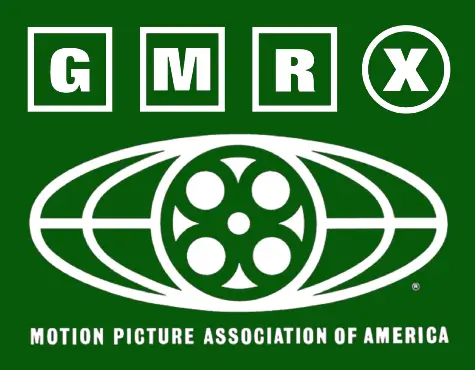
Just weeks later, on Nov. 1, 1968, the MPAA‘s new letter-based ratings system goes into effect, effectively ending the era of movie censorship. While technically “voluntary,” it becomes a de facto legal standard nationwide.

1968 Varsity programming changes with the times
L.J. McGinley, known as “the last of the old-style theater managers,” dies of a heart attack in the theater’s office, ending an era for the Varsity Theatre.
That autumn, new manager Dan Shelhamer shifts the format to favor independent and edgier films as the Sixties counterculture takes hold.
Meanwhile, just up the Ave in the intersection at NE 47th Street, over 7,000 people attend the Love-U District festival with outdoor sets by Santana, The Youngbloods, Frumious Bandersnatch, and others.
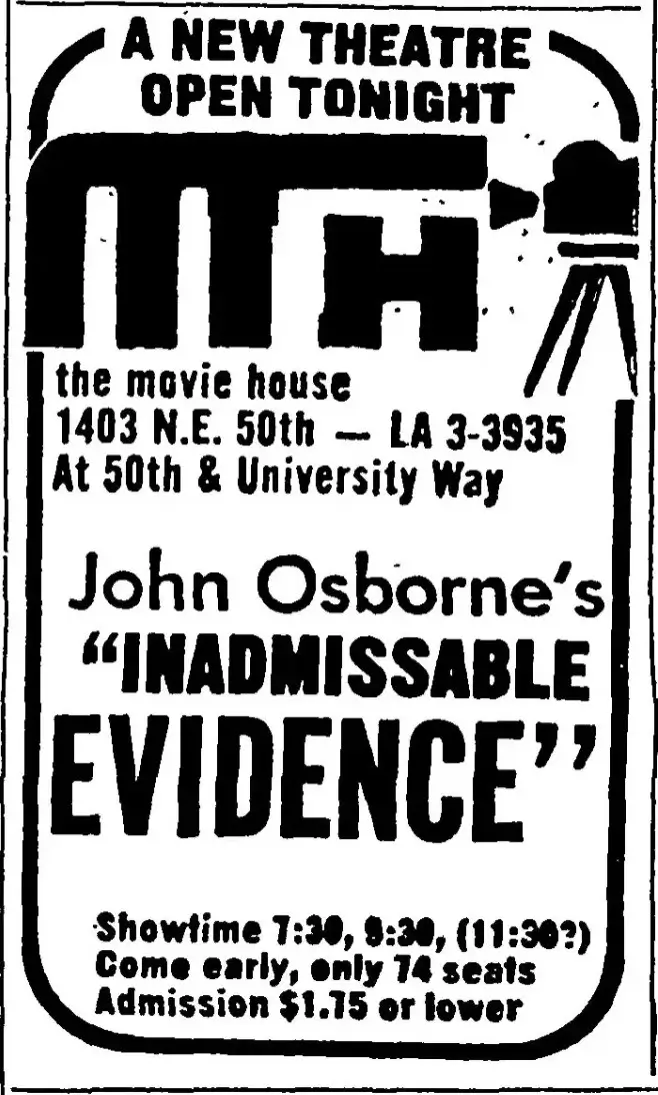
1970 Randy Finley opens The Movie House, which will eventually become the Grand Illusion Cinema
Finley borrows $600 from his father (a State Supreme Court Justice) and along with co-founders Jim Klein (an Air Force vet) and Jim Hatfield (an electrician), converts a dentist’s office into a tiny 76-seat movie theater.
Perched above a florist at the corner of 50th Ave. NE and NE University Way, it becomes a bedrock art-house for the city, showing a wide range of foreign, offbeat, revival, and silent movies.
In December 1971, Finley first books It’s a Wonderful Life, which becomes an annual tradition for the cinema that continues to this day.
In 1973, Ruth Hayler is hired to run the theater, launching what proves to be a five decade career as an influential film programmer for Seven Gables Theatres, Landmark, and SIFF.
1971 United Theatres takes over the Varsity
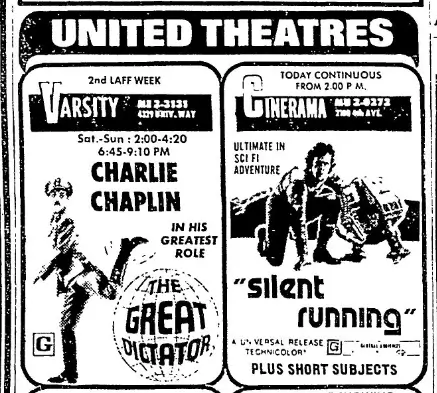
After 32 years, the B.F. Shearer Co. ends its management of the theater. Programming turns to mainstream Hollywood and family fare. At the time, United Theatres (a sister company of California-based Pacific Theatres) also manages the Cinerama, the Ridgemont in Phinney, and several area drive-ins.
A year later, Benjamin F. Shearer passes away and his companies are sold.

1975 Randy Finley and partners found the Seven Gables Theatres chain
Finley, his sister Pat, and Bob McRae buy the Guild 45th Theatre and an old American Legion Hall, converting that into a movie theater they name the Seven Gables (even though the building only had six). Soon they begin buying other struggling neighborhood cinemas.
The purchases are funded largely by profits from Specialty Films, a distributor founded in 1973 by Randy and Pat which had success with movies like King of Hearts, the pivotal repertory re-release of Harold and Maude, Allegro Non Troppo, F For Fake, and others.
Specializing in art-house and repertory programming, the chain grows quickly and eventually expands to 34 screens in 16 theaters across Seattle and Portland, OR. (The Movie House/Grand Illusion was never part of the chain.)
1977 The Movie House sold to Paul Doyle
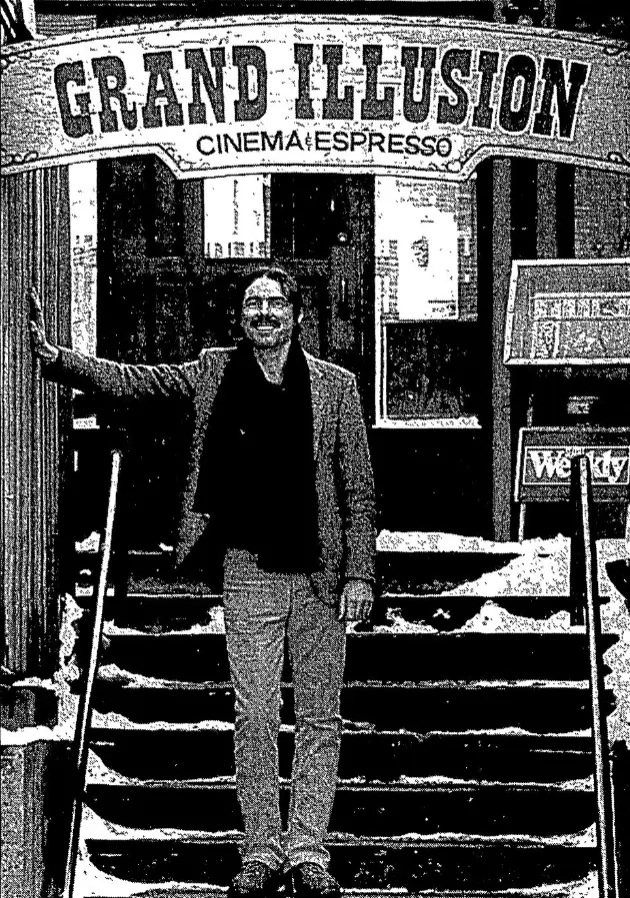
After several years as a film programmer at the Moore Theater and then University Cinemas (at 55th and University Way), Doyle buys The Movie House from Randy Finley.
He upgrades the projection equipment, somehow adds 20 more seats, and installs a tin ceiling salvaged from an 1890 hospital in Salem, OR.
The programming continues to feature art-house and repertory films.

1979 Paul Doyle renames The Movie House as the Grand Illusion
Doyle later tells historian Paul Dorpat that he chose the name not just to honor the classic Jean Renoir film, but also for “the medium of movies itself and, some would say, the nature of life.”
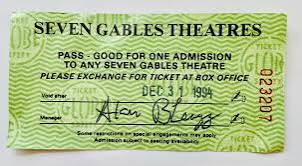
1982 Seven Gables Theatres chain buys the Varsity
Under lead film buyer Bert Manzari, art-house programming returns, blended with suitable first-run Hollywood films. As the Varsity’s reputation grows, major sneak preview screenings are held there.
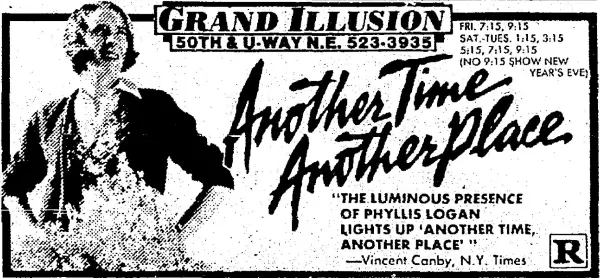
1983 — 1987 Paul Doyle sells (then buys back) the Grand Illusion Cinema
In 1983, Doug Campbell (co-owner of Bulldog News, down the street) partners with Mark Weiss and Peter Bakke to buy the theater.
When they close the Grand Illusion four years later, Doyle steps in to buy it back and reopen. “I hated to see it empty,” he later tells the Seattle Post-Intelligencer. “This theater is sort of my baby.”

Oct. 1984 — Feb. 1985 Seven Gables adds second story and two screens to the Varsity
The theater closes for the duration, except for brief breaks in construction during the holidays. Cinema 2 opens on February 1, 1985. The first date as a full triplex is a week later on Friday, February 8, 1985. Screenings that weekend include The Ballad of Narayama, the Oscar-nominated Places in the Heart, Laurence Olivier in Othello (1965), and The Falcon and the Snowman (which had sneak previewed there).
1989 Landmark Theatres buys the Varsity (but it’s complicated)
Heritage Entertainment acquires Landmark and Seven Gables Theatres in separate deals, and then merges all theaters under Landmark. Except that Seven Gables Theatres keeps its name and lead programmer, but only in Seattle…yet all shows start with “welcome to Landmark Theatres” promos.
In the 1990s, various corporate sales and bankruptcies lead to a series of clunky names (Goldwyn/Seven Gables, Seven Gables/Landmark, Landmark Theatres Silver Cinemas, etc. etc.). Eventually the ghost of the Seven Gables chain disappears entirely, and it’s all just Landmark.


1997 Northwest Film Forum buys the Grand Illusion Cinema
Paul Doyle puts the Grand Illusion up for sale and the WigglyWorld filmmaking cooperative, formed in 1995, decides they need a theater to further their mission. As the deal closes at the end of 1996, they adopt the new name to encompass both exhibition and production. The cinema itself retains its name.
The theater is remodeled to enlarge and revamp the projection booth (reducing the number of seats to 70), and reopens in early 1997 with a largely volunteer staff.
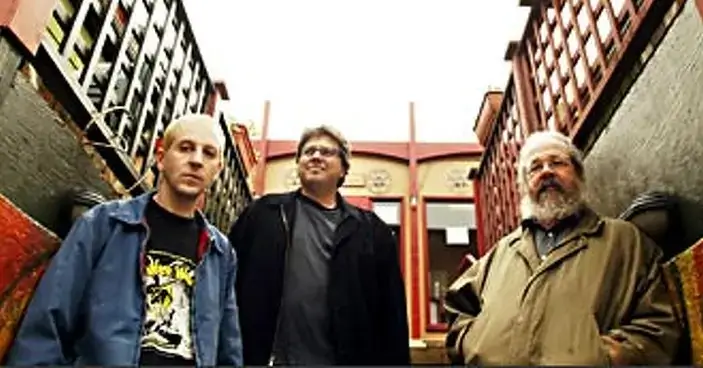
2004 Grand Illusion Cinema becomes its own independent nonprofit
A group of longtime employees form a new nonprofit that buys the theater from Northwest Film Forum. After a month-long renovation, it reopens on April 1 with a volunteer staff and screenings of Rubin and Ed (1991).
The programming continues to follow the classic art-house/repertory format, while expanding to including more genre films. For example, the month-long horror series All Monsters Attack! — the first of its kind in Seattle — debuts in 2007 and becomes an annual tradition.
After the split, Northwest Film Forum closes its other venue, The Little Theatre (on 19th Ave. E), and consolidates operations in a new home on Capitol Hill, where it remains today.
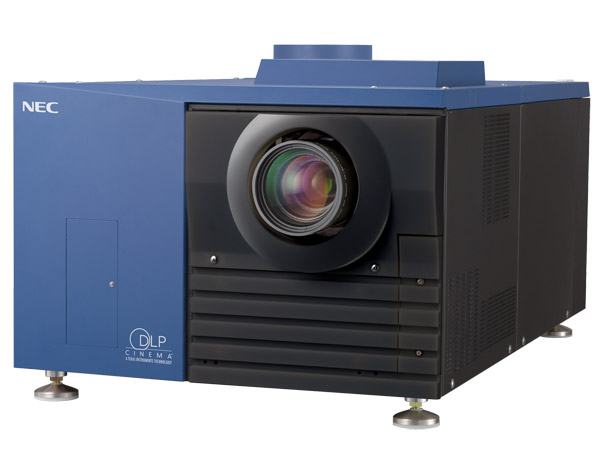
2008 — 2014 Hollywood forces conversion to digital projection
In the biggest technological change for motion pictures since their invention, the film industry cements the shift to all-digital projection. In 2008, the largest studios announce a $1 billion fund to subsidize theaters for the expensive conversion (provided they also throw out their 35mm equipment). In 2014, the major studios stop releasing 35mm film prints of new movies. Today, film survives only as a niche format for special releases.
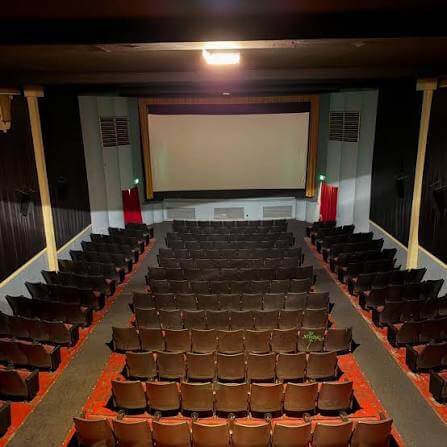
Dec. 2014 Landmark ends operations at the Varsity, which closes
Within three years, the chain closes all of its remaining theaters in Seattle, including other lingering remnants of the Seven Gables chain, the Guild 45th (demolished in 2023) and the original Seven Gables Theatre (burned down in 2020).

Feb. 2015 Far Away Entertainment reopens the Varsity
The independent Puget Sound chain is perhaps best known for owning the Admiral Theater in West Seattle. Following the by-now irreversible industry trend, they finalize the conversion to digital projection and decommission the remaining 35mm equipment. Programming is mostly new releases.

March 23, 2020 — June 30, 2021 COVID 19 pandemic closes all theaters in Washington
Theaters that survive take several months to gradually resume operations as restrictions ease. The market is never the same again, and more theaters close in the following years.
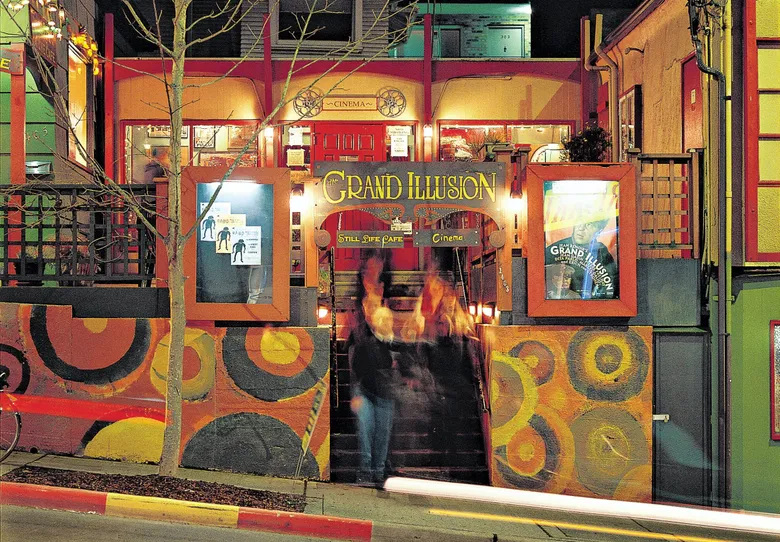
2023 Grand Illusion Cinema’s longtime landlord sells the building
The theater continues operation under its existing lease.
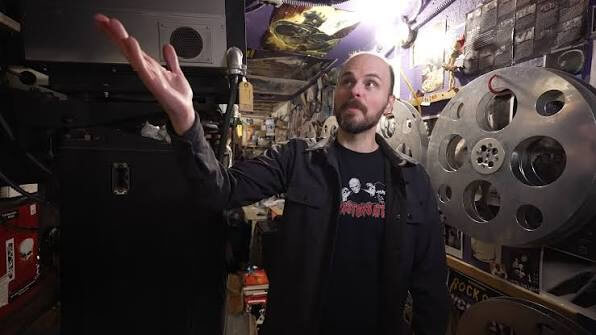
Oct. 2024 The Grand Illusion’s new landlord declines to renew the lease
After 54 years, the longest continually running movie theater in Seattle will be forced to close its doors. During the final months community support is tremendous, and attendance breaks all records.

Jan. 31, 2025 The Grand Illusion runs its last shows in its original location
The final two screenings are Cinema Paradiso and Re-Animator (shown in 35mm).
The cinema begins a period of pop up screenings at other venues in Seattle, while searching for a new permanent home.
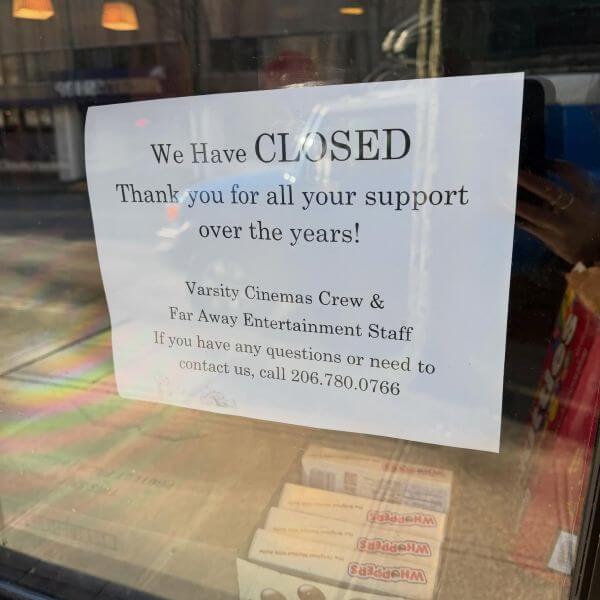
Jan. 2026 Far Away ceases operations at the Varsity, which closes
The regional chain’s other theaters remain open.
For the first time since 1910, the University District has no movie theaters.
Sept. 2026 Grand Illusion Cinema becomes the newest custodian of the historic Varsity Theatre
Tentative grand reopening: late autumn 2026!
Learn more about the Grand Illusion’s plans for the Varsity!